 Douro Valley Wine Tour from Porto
The Best Time to Visit the Douro Valley: Month-by-Month Guide
The best time to visit the Douro Valley is May to June and September to early October, when average highs sit between 23.3°C and 28.8°C and the harvest adds colour to the terraces. July and August are the months to think twice about, because the valley floor reaches 38°C at its hottest and Régua averages more than 20 days a month at 30°C or more. Winter is quiet and cool but almost everything stays open. This page works through the climate numbers, the harvest, the events and the closures so you can match your dates to the valley. If you would rather let someone else drive, a Douro Valley wine tour from Porto takes the driving off your hands.
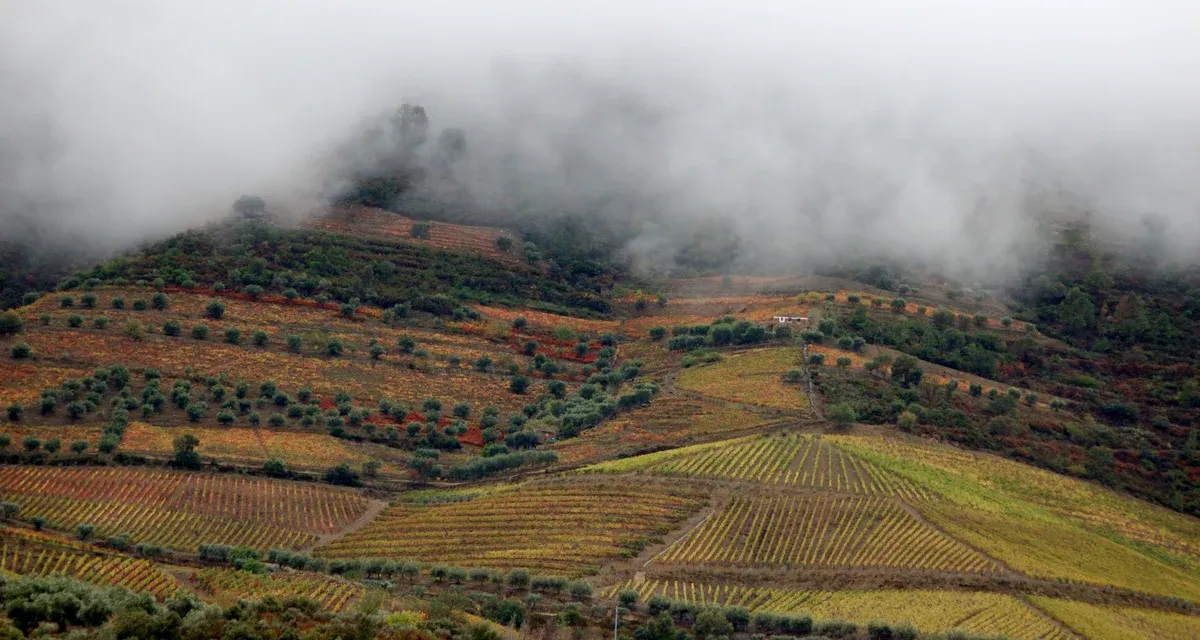
Fog hangs over red and gold vineyards in autumn. Photo: Rosino, CC BY-SA 2.0, via Wikimedia Commons
Quick answer The short answer
The best months to visit the Douro Valley are May, June and the harvest weeks of September to early October. May and June bring average highs of 23.3°C and 28.0°C with little rain and long evenings, before the summer heat sets in. September pairs an average high of 28.8°C with picking in the vineyards, which is the single most atmospheric time to be in the valley. July and August are the hardest months, with valley peaks of 38°C and more than 20 days a month at 30°C or above in Régua.
Key takeaways
- Best window: May to June, average highs of 23.3°C to 28.0°C and under 15 mm of rain in July. See the month-by-month table.
- Runner-up: the harvest from September to early October, warm at 28.8°C but the busiest and priciest stretch. Details in Harvest Season.
- Months to avoid: July and August, with 38°C peaks. Winter is the quiet counterweight, covered in the seasons guide.
- Short on time? A Douro Valley tours from Porto comparison lays out the full-day and half-day options.
The Douro Valley Month by Month
The figures below come from the official Portuguese weather service IPMA, using its climate normals for the Régua station at 65 m, the nearest official Douro station to Pinhão, covering the period 1971 to 2000.
Douro Valley Weather by Month
The table gives the average daily maximum and the average rainfall for each month at Régua, the main river town of the Douro, and one line on what the month means for a visitor. Some months have no figure in the IPMA source, and those cells say so rather than guessing. Treat every number as a long-term average, not a forecast for your dates.
| Month | Average high | Rain | What happens |
|---|---|---|---|
| January | 12.4°C | 113.6 mm | Coolest and one of the two wettest months. Winter hours at the quintas. |
| February | not stated | not stated | Almond blossom starts in the Douro Superior in the second week of February. |
| March | 18.7°C | not stated | Cruise season gets going from mid-March on some operators. |
| April | 20.2°C | not stated | Spring green on the terraces, mild walking weather. |
| May | 23.3°C | not stated | Tasting slots start filling. One of the best all-round months. |
| June | 28.0°C | not stated | Warm and dry. The longest day gives Porto about 15 hours 12 minutes of daylight. |
| July | 31.5°C | 14.5 mm | Hottest month along with August. 310 hours of sunshine in Régua. |
| August | 31.8°C | 13.7 mm | Just as hot, with 21.8 days at 30°C or more on average. |
| September | 28.8°C | 40.1 mm | Harvest. Peak picking falls in the third and fourth weeks of the month. |
| October | 22.8°C | 93.5 mm | Harvest tails off in early October, still warm enough for lunch outdoors. Rain builds. |
| November | not stated | not stated | Cruise season winds down, many quintas shorten hours. |
| December | 13.4°C | 144.3 mm | Wettest month. Some quintas close on 25 December. |
How to Read the Numbers
A newer IPMA set, the 1981 to 2010 normals for Régua at 56 m, puts July and August slightly higher at 31.7°C and 32.1°C and counts 76.4 days a year at 30°C or more, against 71.9 days in the older set. Either way, the Douro floor is a genuinely hot place in summer. In the same newer set Porto records a July maximum of 24.2°C and only 12.4 days a year at 30°C or more, so the valley runs several degrees hotter than the coast you start from.
Rain swings hard between seasons. Régua collects 848.9 mm a year over roughly 116 wet days in the older normals and 819.2 mm in the newer ones, but July and August deliver under 15 mm each. December is the wettest month at 144.3 mm, followed by January at 113.6 mm. September averages 40.1 mm and October 93.5 mm, so the harvest month turns wet by the time the picking ends.
Two cautions. Régua still averages 14.3 nights a year at or below 0°C in the older normals, mostly in January with 6.1 such nights, and December adds 3.4. And the plateau above the valley is a different climate. The Vila Real station at 561.5 m shows a July maximum of 28.6°C, 1,018 mm of rain a year and 19.1 nights below freezing, while Carrazeda de Ansiães at 715 m on the Douro Superior side drops to a January minimum of 0.3°C. Pack for the altitude you are heading to, not just the river. For trains, fares and timetables into the valley, the practical side sits on the Porto to Douro Valley planning guide.
Spring, Summer, Harvest and Winter
Four seasons, four different trips. Each has one honest trade-off.
Spring (March to May): Mild Days Before the Crowds
March averages 18.7°C, April 20.2°C and May 23.3°C at Régua, with about 12 hours 14 minutes of daylight in Porto on 21 March. The river cruise season restarts from mid-March on some operators, and the Douro turns green well before the summer dust arrives. The trade-off is rain. The record gives no per-month spring rainfall figures, but the annual total of roughly 820 to 849 mm is loaded towards the cooler half of the year, so a shower is always possible.
Booking matters from May onwards. Quinta tasting slots between May and October fill quickly, so reserve ahead. A full day like the small-group tour with two wineries, cruise and lunch at $103.21 is one full-day option for these months, and if you want two days rather than one, the 2-day Douro trip from Porto sets out an overnight route.
- Average highs of 18.7°C to 23.3°C, the mildest stretch of the year
- Cruise boats back from mid-March on some operators
- Tasting slots get tight from May, so book ahead
Summer (June to August): Long Evenings, Real Heat
June averages 28.0°C and stays dry, and the longest day gives Porto about 15 hours 12 minutes of daylight with sunrise at 06:00, which makes June arguably the strongest single month in the year. Then July and August arrive. Régua averages 31.5°C and 31.8°C highs, wine guides report peaks reaching 38°C on the valley floor, and the older normals count 20.1 and 21.8 days a month at 30°C or more. Rain is almost irrelevant, at 14.5 mm in July and 13.7 mm in August, and July alone delivers 310 of the valley's 2,201 yearly sunshine hours.
The honest way to handle the heat is to move early. Vineyard terraces hold the afternoon sun, so a morning departure beats a lunchtime arrival. Half-day formats help too, such as the half-day tour with wine, cruise and viewpoint at $67.66, which means less time on the terraces. If you want the full-day version with lunch included, the premium small-group tour with wine, lunch and cruise at $194.96 includes pickup and a group of up to 8.
- June is the sweet spot, 28.0°C and about 15 hours of daylight
- July and August peak at 38°C on the valley floor
- Over 20 days a month at 30°C or more in Régua
The Best Month If You Only Have One Morning
Ranked for a single morning in the valley. First, June, dry at 28.0°C with sunrise at 06:00 and the longest light of the year. Second, late September, when the 28.8°C average high comes with picking underway and the terraces at their most photogenic, though the day shortens to about 12 hours 32 minutes of daylight by mid September.
Third, May, at 23.3°C with green vines and tasting slots that still need booking but are not yet scarce. Fourth, early October, still 22.8°C and warm enough for lunch outdoors, with the risk shifting to rain at 93.5 mm for the month.
The Worst Time to Visit (Honestly)
The hardest stretch is late July through August on the valley floor. Régua records over 20 days a month at 30°C or more, wine guides report 38°C peaks, and shade is thin on the schist terraces. Hikers and anyone sensitive to heat should think hard about these weeks.
Photographers chasing heat haze and deep summer light, and travellers locked to school holidays, can still make it work by starting at dawn and keeping the afternoon on the water. November is the other soft spot, with shortened quinta hours, the tail of the rain and the cruise season winding down.
Winter (November to February): Quiet, Cool, Mostly Open
Winter is colder and wet but far from closed. January averages 12.4°C and December 13.4°C, and December is the wettest month at 144.3 mm. Régua averages 6.1 frost nights in January and 3.4 in December in the older normals. Daylight shrinks to about 9 hours 16 minutes on the shortest day, with sunrise at 07:54 and sunset at 17:10, so plan around a short afternoon.
Opening hours contract rather than disappear. Many quintas shorten hours between November and February and some take visits only by appointment. Quinta do Bomfim runs 09:30 to 18:30 from 1 November to 28 February, Quinta das Carvalhas opens daily except 25 December, and Bomfim closes only 25 December and 1 January. Quinta do Noval takes visitors on weekdays except holidays. The long cruises through the dams stop outside the season, because the dams close for maintenance, so winter trips lean on the train and the quintas instead.
Prices and Crowds Through the Year
September is the top pick for harvest atmosphere and is also the busiest and most expensive month in the valley. Harvest packages at the big quintas typically cost €80 to €200 per person, and accommodation should be booked 6 to 8 weeks ahead for the picking weeks. Shoulder months cost less on the day itself.
Tour prices depend on format. The half-day tour is listed at $67.66 and the full-day small-group tour with two wineries at $103.21. Portugal's 13 national holidays, 4 of which fall on a weekend in the current calendar, create short local demand spikes, and many CP Regional trains run only Monday to Saturday except on public holidays, so a holiday needs a timetable check.
Harvest 2020: Taylor's Quinta De Vargellas, Douro (drone)
Harvest at Taylor's Quinta de Vargellas from the air, the season many visitors aim for. Third-party video by Taylor's Port. This site did not shoot it and has no relationship with the creator.
Harvest Season
The vindima is the reason many people pick their dates, so here is exactly what the sources say.
When the Grapes Are Picked
The harvest window is September to early October, with one guide expecting the peak in the third and fourth weeks of September. It moves. In the current cycle Portuguese press reported the Douro harvest began about two weeks earlier than usual, with the first grapes picked in early August, and Portugal opened a 12 million euro support scheme for growers who left grapes unharvested. So treat the classic window as a guide and expect variation year to year.
If you want to take part rather than watch, harvest packages at the big quintas typically cost €80 to €200 per person, and accommodation for the picking weeks should be booked 6 to 8 weeks ahead. Weather-wise the season is kind. September averages a 28.8°C high with 40.1 mm of rain, and early October holds 22.8°C, still warm enough for lunch outdoors, before the rain builds to 93.5 mm across the month. A guided day in the harvest weeks such as the complete wine tour with lunch, tastings and river cruise at $113.53 is worth booking early.
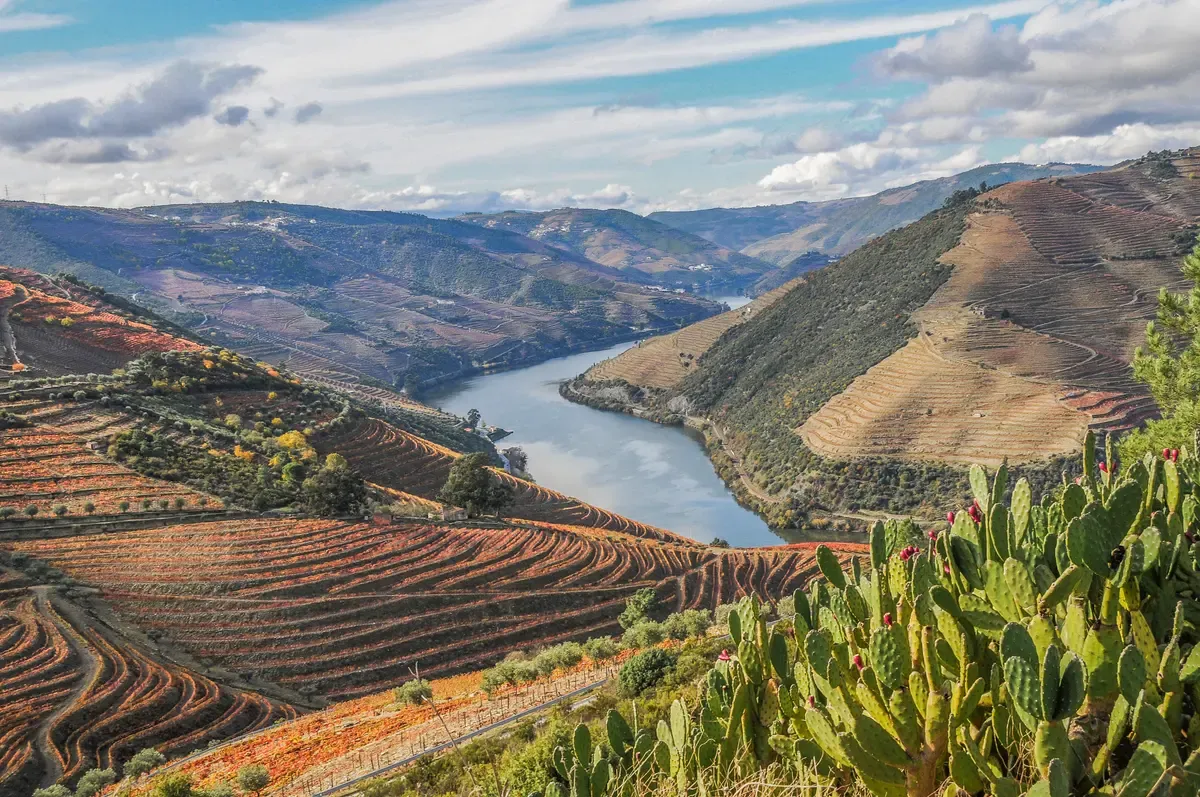
Red and orange vine terraces drop to a bend of the Douro near Tabuaço. Photo: Joseolgon, CC BY-SA 3.0, via Wikimedia Commons
Events and Holidays
Only dated, confirmed events here, plus the national holidays that affect opening hours and trains.
Almond Blossom in Late Winter
Douro almond trees blossom from the second week of February to early March, and the sources place it in the Douro Superior around Figueira de Castelo Rodrigo and Vila Nova de Foz Côa. None of them confirms blossom near Pinhão. Figueira de Castelo Rodrigo has held its Festa da Amendoeira em Flor since 1941, and its 85th edition ran over two weekends in late February and early March.
Vila Nova de Foz Côa ran its almond blossom festival from 14 February to 8 March in the same cycle. It is a reason to visit in the cold months.
The Remédios Festival in Lamego
Lamego's Festas em Honra de Nossa Senhora dos Remédios ran for about two weeks into early September, ending on 9 September, with 8 September, the Nativity of the Virgin, as the key day. The Procissão de Triunfo procession has more than 130 years of history and is the high point. It overlaps with the start of the harvest window, so Lamego is at its liveliest exactly when the vineyards are being picked.
Public Holidays That Affect Your Trip
Portugal has 13 national holidays, and 4 of them fall on a weekend. They are 1 January, 3 April, 5 April, 25 April, 1 May, 4 June, 10 June, 15 August, 5 October, 1 November, 1 December, 8 December and 25 December. Three practical notes. The 5 October holiday falls on a Monday, so a Monday-closed museum is shut anyway, but private quintas and shops may also close. Many CP Regional trains run only Monday to Saturday except on public holidays, so a trip on 1 December or 8 December needs a timetable check. And 25 December closes Quinta das Carvalhas and Quinta do Bomfim, with Bomfim also shut on 1 January.
One culture caveat. Museu de Lamego closed for renovation works funded with 1.75 million euros, including a new roof and an external lift, and it cannot be counted on for an itinerary until it reopens. The Lamego cathedral keeps free admission with listed hours of 08:00 to 13:00 and 15:00 to 19:00. For context, the Alto Douro Wine Region was inscribed on the UNESCO World Heritage List on 14 December 2001 and covers about 24,600 ha of terraced vineyards.
Frequently Asked Questions
What is the best time of year to visit the Douro Valley?
May and June, and the harvest window of September to early October. May averages 23.3°C and June 28.0°C at Régua, September holds 28.8°C with the picking underway. The month to weigh carefully is July or August, when the valley floor can reach 38°C. A Douro Valley wine tour from Porto runs in all twelve months.
Is the Douro Valley colder than Porto?
No, the valley floor is much hotter than Porto in summer. The newer IPMA normals count 76.4 days a year at 30°C or more in Régua against 12.4 in Porto, with a July high of 31.7°C against 24.2°C. The plateau towns reverse it, since Vila Real at 561.5 m records 19.1 frost nights a year. See the month-by-month climate table.
When is harvest season in the Douro Valley?
September to early October, with peak picking in the third and fourth weeks of September. The timing shifts, and in the most recent cycle the first grapes came in about two weeks early. Participation packages at the big quintas typically cost €80 to €200 per person. More detail in Harvest Season.
What is the Douro Valley like in November?
Quiet, cool and damp. The cruise season winds down, with one operator running until November and others stopping in October, and many quintas shorten hours between November and February, some taking visits only by appointment. If you go, lean on the train line and the quintas that keep daily opening, such as Quinta das Carvalhas. The guide to Peso da Régua covers the main river base.
How many days do you need in the Douro Valley?
One day works and is what most visitors do, but it is tight. A same-day train trip from Porto realistically gives 5 to 6 hours in the valley after about 4 to 5 hours of travel. Two days let you add a quinta afternoon and a second river town. The 2-day itinerary from Porto sets out the overnight option.
Can you visit the Douro Valley wineries in winter?
Yes, with shorter hours. Quinta do Bomfim runs 09:30 to 18:30 from 1 November to 28 February and closes only 25 December and 1 January, Quinta das Carvalhas opens daily except 25 December, and Quinta do Noval takes visitors on weekdays except holidays. December is the wettest month at 144.3 mm, so pack for rain. The Douro Valley wineries guide lists the estates.