 Douro Valley Wine Tour from Porto
Porto to Douro Valley by Train: Timetable, Fares and the Line Explained
Going from Porto to Douro Valley by train is the cheapest way to reach the river on your own, on the Douro line from Porto Campanhã to Régua, Pinhão and Pocinho. This page owns that journey in full. It lists every InterRegional departure and arrival time, the trains back, the fares, how to buy, which side to sit on and what each station offers. It also covers the historic Douro train and the way the line combines with a boat. If you would rather hand the whole day to someone else, the tours section at the end covers that honestly too, including the full day by boat and train. The bookable tours are compared on all Douro Valley wine tours from Porto.
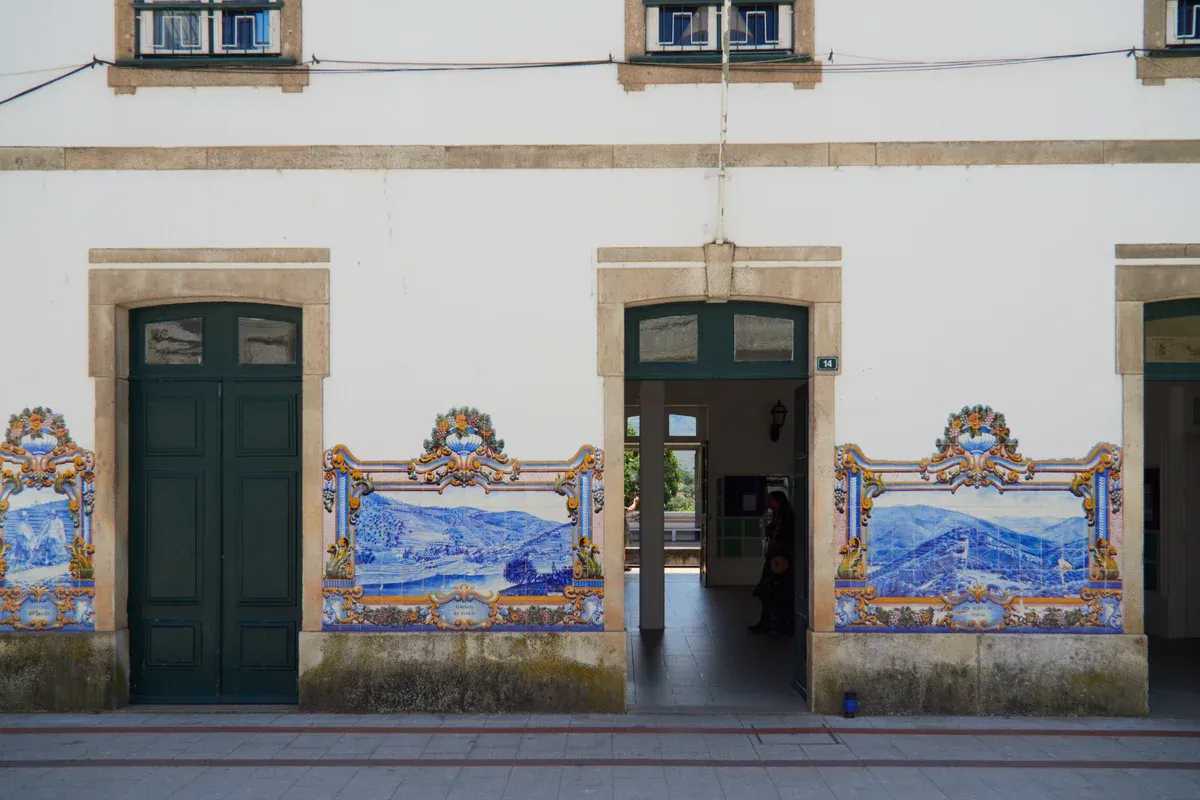
Blue azulejo panels of Douro landscapes decorate a station on the Douro line. Photo: lumoplank, CC0, via Wikimedia Commons
Quick answer The Douro train in one minute
The 07:30 InterRegional from Porto Campanhã reaches Pinhão at 09:51, so the ride to the heart of the valley takes 2 hours 21 minutes. The fare is about €12 to Pinhão each way, there is no seat reservation and tickets cannot sell out. The same train calls at Peso da Régua at 09:25 and Pocinho at 10:50. Urban trains from São Bento only reach Marco de Canaveses, so Régua and Pinhão need the through IR services from Campanhã.
Key takeaways
- The IR trains leave Campanhã at 07:30, 09:30, 13:30, 15:25 and 17:30, and the 07:30 and 09:30 both reach Pinhão before noon, per the Douro line timetable.
- Fares run about €12 to Pinhão and about €11 to Régua, with children 4 to 12 at half fare and 50 percent off for seniors 65 and over, see tickets and seats.
- Sit on the right side travelling east for the river views, and plan your return around the trains back, the last of which leaves Pinhão at 20:24.
- If the timetable looks tight, the zero-hassle alternative is the full-day boat, train and lunch tour at $197 or the classic wine tour with lunch and cruise at $113.53.
Which Train Suits You
If You want the maximum time in Pinhão on a day trip, then take the 07:30 IR from Campanhã, which arrives at 09:51, and return on the 16:41 or 18:11 train for roughly 6 to 8 hours by the river.
If You are staying near São Bento in the old town, then ride the urban train 4 minutes to Campanhã first, or start with a São Bento urban service to Marco de Canaveses and change.
If You are visiting Régua rather than Pinhão, then the same 07:30 train gets you there at 09:25 after about 1 hour 55 minutes, and Régua has 12 listed departures back toward Porto across the day.
If You travel with children aged 4 to 12 or with a senior 65 or over, then budget half fare per child and 50 percent off per senior on top of the about €12 adult fare to Pinhão.
If You have one shot at the valley and hate logistics, then a Douro Valley wine tour from Porto does the driving and the booking for you, such as the full-day boat, train and lunch tour.
Douro Line Timetable from Porto
The CP timetable valid since 5 August runs InterRegional, Regional and Urban trains on the Douro line. The IR services start at Campanhã, not São Bento, and are the trains that carry you deep into the valley.
Trains from Porto to Pinhão and Pocinho
Five through departures a day leave Porto Campanhã for the upper Douro, at 07:30, 09:30, 13:30, 15:25 and 17:30. The 07:30 is the classic day-trip choice because it puts you in Pinhão at 09:51, early in the day. The 09:30 arrival at 11:46 still gives a full afternoon. The 17:30 reaches Pinhão at 19:49, which is too late for a same-day return, so it only makes sense with an overnight stay. If your plan is Régua, every one of these works, since Régua comes first at 09:25, 11:20, 15:19, 17:11 and 19:24 respectively.
For the whole route, Porto São Bento to Pocinho is about 175 km and takes roughly 3 hours 25 minutes on the slowest services. Seat61 counts 5 or 6 trains a day from Porto to Pinhão and Pocinho. The line itself has 44 stations between Ermesinde and Pocinho, opened in stages between 1875 and 1887, and is electrified only as far as Marco de Canaveses. Between Pinhão and Pocinho the train stops at Tua, Alegria, Ferradosa, Vargelas, Vesúvio and Freixo de Numão - Mós do Douro. Tua is 15 minutes beyond Pinhão on the 09:51 service, arriving at 10:06.
| Leaves Campanhã | Régua | Pinhão | Pocinho |
|---|---|---|---|
| 07:30 | 09:25 | 09:51 | 10:50 |
| 09:30 | 11:20 | 11:46 | 12:45 |
| 13:30 | 15:19 | 15:45 | 16:44 |
| 15:25 | 17:11 | 17:37 | 18:41 |
| 17:30 | 19:24 | 19:49 | not stated |
Trains Back from Pinhão to Porto
The return board matters more than the outbound, because missing the last train is the one real risk of a DIY day. From Pinhão the departures toward Porto are 08:08, 12:18, 14:07, 16:41, 18:11 and 20:24. The 12:18 reaches Campanhã at 14:35 after about 2 hours 17 minutes. The 14:07 arrives at Campanhã at 16:30. The 16:41 reaches Régua at 17:06 and connects into the 17:12 from Régua, which arrives at Campanhã at 19:00 and São Bento at 19:05.
The evening options are slower and may involve a change at Régua, so check cp.pt for the 18:11 and 20:24 before relying on them. The 18:11 from Pinhão reaches Régua at 18:36, and the 18:37 from Régua arrives at Campanhã at about 20:30. The last train leaves Pinhão at 20:24, reaches Régua at 20:49, and the last through service from Régua at 21:07 arrives at Campanhã at 23:35 and São Bento at 23:40. From Régua itself the timetable lists departures to Porto at 05:28, 06:44, 08:39, 09:00, 10:33, 12:44, 13:08, 14:33, 17:12, 18:03, 18:37 and 21:07, so Régua day trippers have far more choices than Pinhão day trippers.
Two warnings from CP. Some Regional trains run only Monday to Saturday except public holidays, so Sunday and holiday timetables are thinner. And train connections are only guaranteed under normal operating conditions, so leave buffer on any tight connection. CP also notes that train 4001 at 22:25 Monday to Saturday may be replaced by a bus between Marco de Canaveses and Régua. Régua to Pinhão itself takes 25 minutes on the 09:26 IR departure, calling at Covelinhas and Ferrão, useful if you base in Régua and ride down for the afternoon.
| Leaves Pinhão | Régua | Porto Campanhã |
|---|---|---|
| 08:08 | 08:39 | 10:30 |
| 12:18 | 12:44 | 14:35 |
| 14:07 | 14:32 | 16:30 |
| 16:41 | 17:06 (change, 17:12) | 19:00 |
| 18:11 | 18:36 (change, 18:37) | about 20:30 |
| 20:24 | 20:49 (change, 21:07) | 23:35 |
Sources: CP Douro line timetable, Quinta do Bomfim (Symington)
Tickets, Fares and Seats
Douro line tickets are fixed price, there is no seat reservation and trains cannot sell out, so buying is low stress. The only decisions are where to buy and whether a discount applies.
What the Trip Costs
The line is cheap. Expect about €12 each way from Porto to Pinhão and about €11 to Régua, with Pocinho a little more. CP fares rise each January and the guides differ by a few cents, so confirm the exact fare on cp.pt before you travel.
Children aged 4 to 12 pay half fare and seniors 65 and over get 50 percent off according to a local guide, so check cp.pt for the discounts too. A same-day trip realistically gives you 5 to 6 hours in the valley after about 4 to 5 hours of travel.
| Route | Seat61 single | Local guide single | Local guide return |
|---|---|---|---|
| Porto to Régua | not stated | about €11 | check cp.pt |
| Porto to Pinhão | about €12 | about €12 | check cp.pt |
| Porto to Pocinho | about €15 | about €15 | check cp.pt |
Buying Tickets and the Siga Card
The CP app and online ticket office sell Regional, InterRegional and Porto urban trains up to 60 days ahead and need a myCP account, which is the easiest route. Station counters also sell tickets, but CP warns counters can be closed on evenings and weekends, so do not count on buying at Pinhão for the ride back. Porto urban trains work differently and need a Siga card costing €0.50, valid one year, and tickets must be validated before boarding.
The Andante Azul card costs €0.60 and Andante Tour passes give unlimited travel for 24 or 72 hours on the Porto network, which covers the hop between Campanhã and São Bento. Each passenger may carry one personal item free of charge on CP trains, fitted in the racks or under the seat. One gap worth knowing, bicycles are not allowed on the Regional trains of the Douro line.
Because seats are unreserved, the local guide advises arriving early at Campanhã for a window seat.
- Buy in the CP app or online up to 60 days ahead with a myCP account.
- No reservation, fixed price, no sellout, so you can also pay at the counter on the day.
- Validate any urban-train Siga or Andante ticket before boarding, cards cost €0.50 to €0.60.
The Douro Valley Train: Porto to Pocinho
Seat61 films the whole Douro line from Porto to Pocinho through the window. Third-party video by The Man in Seat 61. This site did not shoot it and has no relationship with the creator.
On Board: Which Side and What to Expect
The Douro line hugs the river for long stretches and the views are the reason to take the slow train. A little preparation makes the difference between staring at a rock face and watching the terraces slide past.
Sit on the Right Going, the Left Coming Back
Travelling east from Porto, the river is on the right hand side from Porto through Tua to just before Ferradosa, then it switches to the left for the last stretch to Pocinho. For the return from Pinhão to Porto the local guide recommends the left side. In practice this means grab a right hand window on the way out and a left hand window on the way home, and you will have the river beside you for almost the whole ride.
Because seats are unreserved, being on the platform at Campanhã early is how you get one.
- Eastbound from Porto to just before Ferradosa, river on the right.
- Final stretch into Pocinho, river on the left.
- Pinhão back to Porto, river on the left.
Carriages, Wi-Fi and Food
Two kinds of rolling stock work the line. Some Douro trains are classic carriages with wide opening windows, which photographers love, and others are air-conditioned diesel units without opening windows. There is no Wi-Fi, mobile signal is patchy in the gorges, and there is no food or drink trolley, only toilets on board, so bring water and a picnic.
That is not a hardship in Pinhão, where the station and the riverside are steps from the platform, but it matters if you aim for Pocinho. The Linha do Douro runs about 160 km between Ermesinde and Pocinho on 1,668 mm Iberian gauge, and the sections through the valley are slow and winding by design, which is exactly what makes the ride worth the fare.
- No Wi-Fi, no trolley, toilets only, so carry your own food and water.
- Classic carriages open their windows, newer units do not.
- Patchy mobile signal in the gorges, download anything you need in advance.
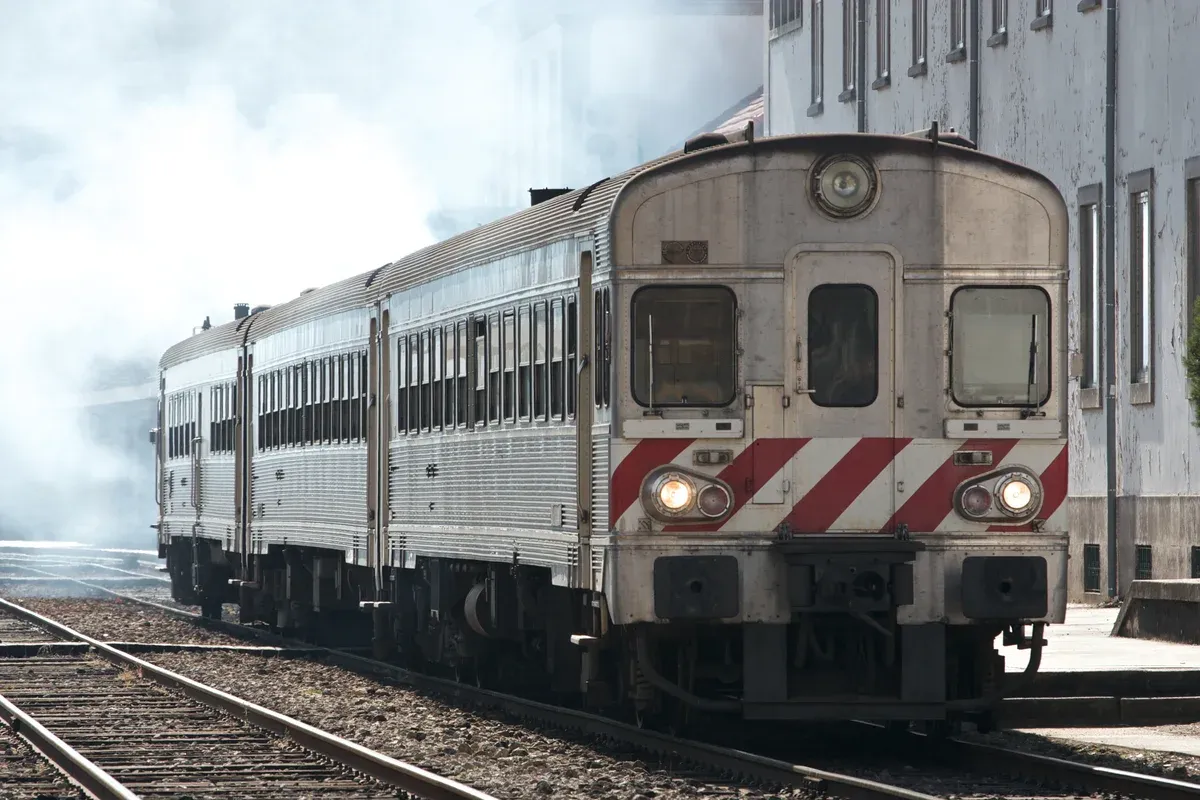
A regional train waits at Régua station on the Douro line. Photo: Nuno Morão from Lisboa, Portugal, CC BY-SA 2.0, via Wikimedia Commons
Régua, Pinhão, Tua and Pocinho
Four stations cover almost every DIY trip on this line. Each one feels different, and what is around the platform should shape how long you stay.
Peso Da Régua
Régua is the working capital of the Douro wine region, a municipality of 16,424 residents on 94.86 km2 that the OIV named the International City of Vine and Wine in 1988. The IVDP, the body that regulates Douro and Port wine, has its head office here. The most convenient wine stop is the Solar do Vinho do Porto at Rua da Ferreirinha, a restored 18th-century manor opened by the IVDP in 2004 with a Port and Douro wine bar, shop and garden.
Hours are listed as Monday to Saturday 11:00 to 20:00 and closed Sundays and holidays on one portal and only Friday and Saturday afternoons on another, so call +351 254 320 960 before a special trip. Régua also hosts festivals such as Nossa Senhora do Socorro in August and the Feira do Livro do Douro, and Douro Wine City 2026 filled the Auditório Municipal for nine days with 82 wine exhibitors. With 12 departures a day toward Porto, Régua is the flexible base on the line, and the Peso da Régua guide takes it further.
Pinhão
Pinhão is the station most people come for, at km 118 of the line, and the building itself is the first sight. The interior is covered in 24 blue azulejo panels from 1937 showing the grape harvest and port wine production, made by the Aleluia factory in Aveiro. The village of 622 residents sits on a loop of the river with an Eiffel-designed road bridge and a historic metal railway bridge.
Quinta do Bomfim is open daily 10:00 to 19:00 from 1 March to 31 October, and Quinta das Carvalhas runs wine flights from €17 plus a €15 shuttle sightseeing tour. A one hour rabelo trip from Pinhão to Romaneira and back costs €15, and a 2 hour Pinhão to Tua cruise costs €30. The train drops you right in the middle of all of it.
How to fill a whole day on foot is covered in the Pinhão Douro Valley guide and the free day trips from Porto hub.
Tua
Tua is the quiet stop, 15 minutes beyond Pinhão on the 09:51 service, arriving at 10:06. Its claim to history is the Linha do Tua, the narrow gauge branch that opened in 1887 and closed in 2018, which at 133.8 km was the longest of the narrow gauge lines north of the Douro. The Tua valley lies inside the Alto Douro Vinhateiro between the Pinhão river valley and Carrazeda de Ansiães.
For walkers there is a marked route from Tua station to Brunheda along the old Tua line, 22 km taking about 5 hours, which only fits the day if you arrive on the 07:30 train and accept a very long outing. Most travelers use Tua as a short leg-stretch stop or as the turning point of the 2 hour Pinhão to Tua boat cruise instead.
Pocinho
Pocinho is the end of the line, reached at 10:50 on the 07:30 departure from Campanhã. There is little here beyond a couple of bar-restaurants, one being A Taberna da Julinha about 7 minutes on foot from the station, so the village is a base for the Douro Superior landscape rather than a place with a sightseeing list. The practical use of Pocinho is simple.
Riding to the terminus means you see the river switch from the right side of the train to the left just before Ferradosa. The 07:09 from Pocinho reaches Pinhão at 08:08, Régua at 08:39 and Campanhã at 10:30, and check the afternoon options on cp.pt before committing.
The Historic Douro Train
The Comboio Histórico do Douro is the vintage way to ride the most scenic stretch of the line, between Régua and Tua through Pinhão, and it runs on a fixed seasonal calendar.
Dates, Times and What You Ride in
In 2026 the historic train runs from 6 June to 18 October on Saturdays, Sundays and some Wednesdays. It leaves Régua at 15:32, reaches Tua at 16:35, leaves Tua at 17:07 and is back in Régua at 18:22, with a stop at Pinhão station from 17:25 to 17:50 on the return leg. Note the locomotive.
In 2026 it is a 1960s diesel pulling five early 20th-century carriages with 254 seats, not the CP 0186 steam locomotive, so do not book it expecting steam. Fares are €60 for adults, €32 for children aged 4 to 12 and €56 each for groups of 10 or more. Tickets can be bought up to 60 days in advance at CP counters, online or in the CP app, and they are non-exchangeable and non-refundable, so pick your date with care.
| Stop | Time |
|---|---|
| Leaves Régua | 15:32 |
| Arrives Tua | 16:35 |
| Leaves Tua | 17:07 |
| Pinhão stop | 17:25 to 17:50 |
| Back in Régua | 18:22 |
Combining It with a Boat
Two packages bolt the historic train onto a cruise. Cruzeiros Douro sells a Régua to Pinhão cruise plus historic train for €135, boarding at the Régua pier at 12:00 and arriving in Pinhão at 15:00, with the historic train leaving Pinhão at 16:20 and the group back in Régua around 18:26. That cruise includes a port wine aperitif and a lunch of grilled veal with pepper sauce, and the package runs June to October.
At the top end, a Porto to Régua boat plus historic train day package costs €165 per adult, leaves Vila Nova de Gaia at 08:00 and returns to Campanhã around 20:30 on the 18:40 regular train from Régua. Both are honest alternatives to building the combination yourself from the regular timetable above.
The Zero-Hassle Option
Everything above you can do alone for about €12 each way. Tours cost more, but they remove every decision about timetables, connections and last trains.
Several Tours That Use the Train or Replace It
The closest match to this page is the Porto: Douro Valley Full-Day Boat, Train and Lunch Tour at $197, which bundles a Pinhão boat cruise, lunch at a typical Douro restaurant, a panoramic train ride and a winery visit with tasting into 7 hours. The guide meets you at Trindade, hotel pickup is not offered, and cancellation is free up to 24 hours. If you would rather skip the train entirely, the Complete Douro Valley Wine Tour from Porto with Lunch, Tastings and River Cruise at $113.53 costs less than the boat-and-train day and includes two wine estates with tastings, a traditional lunch and a 50-minute rabelo cruise from Pinhão, with a meeting point next to Porto Cathedral.
The trade is simple. The train day gives you freedom and costs about €12 each way, the tours give you a fixed plan, tastings and lunch for $113.53 to $197. If you want to compare more options, the Douro river cruise from Porto page and the Douro Valley wine tour from Porto homepage cover the full range.
Porto to Douro Valley by Train: Questions
How long is the train ride from Porto to the Douro Valley?
To Pinhão, the journey takes 2 hours 16 minutes on the 09:30 IR and 2 hours 21 minutes on the 07:30. Régua is about 1 hour 55 minutes away and Pocinho about 3 hours 25 minutes from São Bento on the slowest services. Full arrivals are in the Douro line timetable.
How much does the Porto to Pinhão train cost?
About €12 each way. Check cp.pt for the exact fare. Children 4 to 12 at half fare and 50 percent off for seniors 65 and over. More on fares is in the fares table.
How do I get from Porto to the Douro Valley by train on my own?
Take an InterRegional train from Porto Campanhã at 07:30, 09:30, 13:30, 15:25 or 17:30. These start at Campanhã, which is 4 minutes from São Bento by urban train, while the São Bento urban services only go as far as Marco de Canaveses. The tickets and buying section covers fares and the Siga card.
What time is the last train back from Pinhão to Porto?
The last departure from Pinhão is at 20:24, reaching Régua at 20:49, then the 21:07 through service from Régua arrives at Campanhã at 23:35 and São Bento at 23:40. Connections are only guaranteed under normal operating conditions, so check the return board before relying on the last train.
Is it worth going to the Douro Valley from Porto by train?
Yes, if you want the river scenery and freedom at the lowest price, because the line runs right along the water and the fare is about €12 to Pinhão with no reservation needed. If you would rather not manage timetables, the boat, train and lunch tour bundles the same railway into a 7-hour guided day.
Which side of the train should I sit on for the Douro views?
Right side going east from Porto through to just before Ferradosa, left side for the final stretch to Pocinho, and left side again for the return from Pinhão. Seats are unreserved, so arrive early at Campanhã. More detail is in the on-board section.